

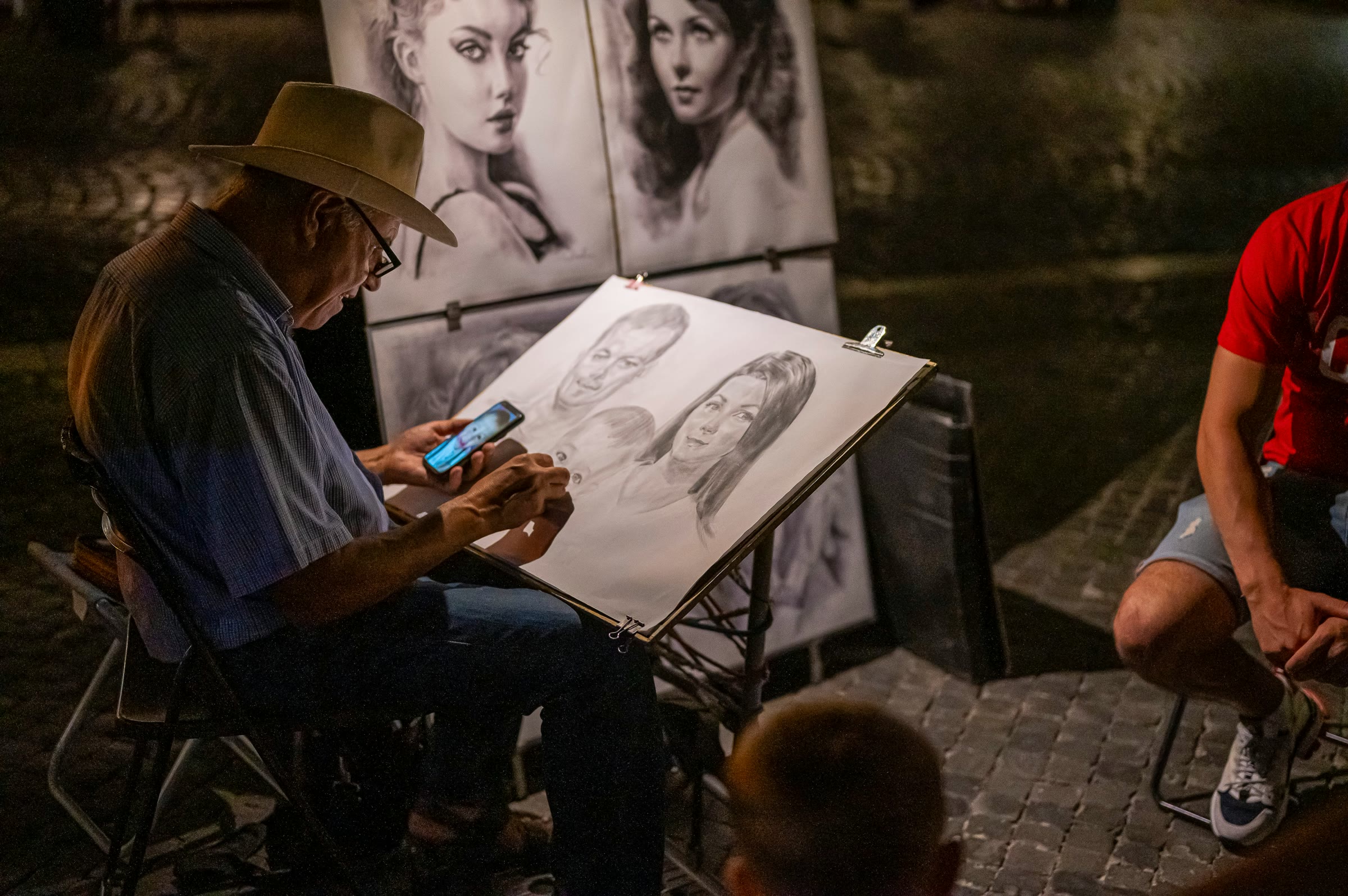
In New York's Greenwich Village, a tourist asked a street artist to draw a portrait. The artist produced an excellent sketch in a few minutes and charged $100. The tourist liked the drawing and paid, but added a comment. "That's expensive, but I'll pay it because it is a great sketch. But, really, it took you only five minutes."
The artist replied:
"Twenty years and five minutes."
Economist Thomas Sowell used this anecdote in his 2000 book Basic Economics to explain the value of human capital: the skills people build over time. He later told the same story in his essay collection Controversial Essays (2002). It is not clear, though, who the artist actually was or where the story first began.
The drawing took five minutes, but learning to draw it in five minutes took twenty years. Generative AI adds an uncomfortable question to this old story.
Then whose twenty years go into a drawing that AI makes in five minutes?

Why generative AI looks a little different to developers
I am a software developer. Watching the debate around generative AI, I sometimes feel that developers and content creators see the same technology quite differently. Not all developers are positive about AI, and not all creators are negative about it. But there are clear differences in the cultures of production that the two fields have developed over time.
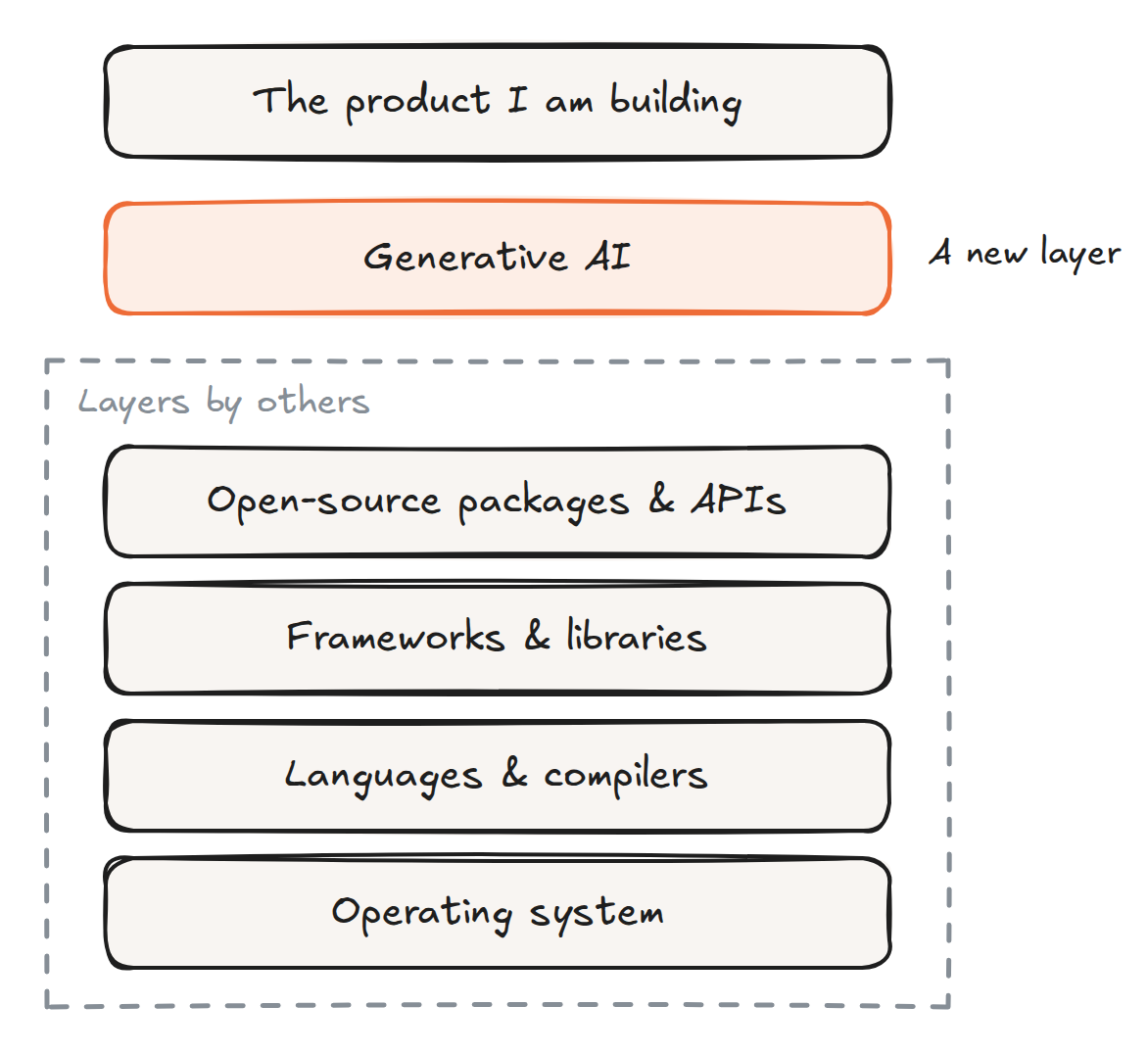
Software developers rarely make everything on their own from scratch. We build programs on operating systems, use programming languages and compilers, and bring in frameworks and libraries. We combine open-source packages and call APIs built by other developers.
There is an old saying among developers: "Don't reinvent the wheel." If someone has already written a good sorting algorithm, most developers do not implement it again from scratch. Using a proven solution and spending the time saved on a new problem is usually the better choice. Using good abstractions is part of good software development.
In a sense, the history of software has been a history of making it unnecessary to rebuild what earlier generations built. Along the way, developers have grown accustomed to this way of making things.
Contributions from countless people + tools + libraries + automation → one product
Even a program written by one person may indirectly contain the work of hundreds or thousands of others. So to developers, generative AI can feel like one more layer on top of the many layers of abstraction already there. What matters more than whether someone typed the code themselves is whether it works correctly, passes tests, and can be maintained.
There is an important premise here, though. Open source is not code that belongs to no one. Open-source projects have licenses and contributors, and rules that specify what can be used and under what conditions. The core of open-source culture is not taking anything you want. It is the rules that communities have spent years refining for building something new on other people's contributions.
This is precisely where generative AI both resembles open-source culture and differs greatly from it. Both are built on the work of many people. But image generation models were trained on large collections of images gathered from the internet, and many artists learned only afterward that their work had been included in that data, without consent, attribution, or compensation.
For creators, the finished work is not the only product
The situation is a little different for illustrators. A developer's authorship of a program is not seriously called into question just because they used libraries to finish it. With a drawing, though, who drew it and how they drew it directly affect its value.
The way an artist draws a line, their habits with color, how they depict eyes, the preferences in composition and form they have developed over years. These are not simply production techniques. They are what distinguish one artist from another.
Returning to the street artist's story, the tourist did not buy just a few lines on paper. They also bought the twenty years that made it possible to draw those lines in five minutes.
Generative AI has unsettled this relationship. Someone can now get a similar result with a few sentences and a little time, without years of practice in a particular form of expression. The problem creators feel may not be just that "AI makes drawings faster than people do." The more fundamental question is this.
Where did the twenty years that made those five minutes possible come from?
And did the person who put in those twenty years consent to their work being used in that process?
That is why the debate around generative AI is a debate about productivity, but also about authorship, consent, and control.
Projects such as Glaze can be understood in this context. Developed by a research team at the University of Chicago, Glaze adds subtle changes to artwork that are barely visible to the human eye, making AI models perceive the work as an entirely different style. The goal is to produce results that differ from expectations even if someone fine-tunes a model on the artist's work to imitate their style.
Are games art or software?
From this perspective, the game industry's position is interesting. Games are clearly creative content. But the way games are made is much closer to software development than to individual creative work.
Many people contribute to a single game: concept artists, 2D artists, 3D modelers, animators, sound designers, writers, level designers, programmers, and others. Production has long used automation technologies such as procedural generation, physics simulation, motion retargeting, shaders, automatic LOD generation, and texturing tools. The finished work is also often seen as a product made by a team and a company, rather than the work of a particular individual.
Nor is everything made during game production part of the final work. There are rough images for sharing ideas, temporary assets for prototyping, and intermediate results for choosing one of dozens of variations. In this environment, generative AI can more readily enter as something like an automation tool in an existing production pipeline than as a tool in an individual creator's studio.
This does not mean, of course, that game developers welcome generative AI unconditionally. Even within the same game company, the company and individual creators may have different interests. But at least a culture in which many contributors make one result, combining many tools and forms of automation, is likely one factor in how the software and game industries adopt generative AI.
The question may not be whether to use AI
At this point, dividing the generative AI debate into support and opposition starts to seem a little strange. Should we use AI? Should we allow AI-generated art? Should we prevent AI training? One approach is to settle on a single answer to these questions and apply it to every user.
Bivri has chosen a different direction. We believe creators should be able to choose, rather than have the platform settle on one answer.
If people are free to use AI, they should also be free to want their work kept out of AI use. If people can upload AI-generated content, those who want to explain how it was made should have a way to display that information. Above all, creators should be able to control the data they create.
This also connects to why Bivri chose AT Protocol.
Does data belong to the platform or the user?
Bivri is being built on AT Protocol. In AT Protocol, user data is recorded in a signed data repository, and account identity is designed to be portable rather than tied to a particular hosting provider.
On traditional platforms, leaving often meant losing the identity and data you had built there. AT Protocol separates services from user data as much as possible. This is also the starting point for Bivri's view of data sovereignty. I explained this structure in detail in the previous post.
In the age of generative AI, though, having your data is not enough. How that data is used has become important too.
I would rather my artwork not be used for training
Bivri lets people choose to apply an AI training protection treatment called Dazzle when uploading images. Dazzle started from concerns similar to those behind Glaze. It adds subtle noise to an image that is hard for the human eye to notice, making it difficult to imitate the art style even if someone fine-tunes a model on that drawing.
Not every creator wants their published work used to train generative AI. But forcing protection on every image is not what Bivri wants either. Some artists want protection; others may decide they do not need it. Artists also differ in how much of the visible effect of noise they are willing to accept. So protection is off by default, and artists choose whether to enable it and set its strength each time they upload. Once processing is complete, they compare the original and processed versions in a preview, then publish the image themselves.
What matters is that the platform does not decide for them: the person uploading gets to choose.
I do not see AI training protection technology as a perfect barrier. Generative models and training methods keep changing, and the Glaze team also states that these tools are not a permanent solution. Bivri likewise labels Dazzle an experimental feature and warns that it may be less effective against the latest generative AI models.
Still, there is a clear difference between creators having no options and being able to express their wishes and use technology that aligns with them.
Was this image made with AI?
We also need choices in the other direction.
When uploading artwork, artists can disclose their AI use themselves by choosing "No AI used," "Some AI used," or "AI-generated." If they want, they can also have Sightengine check how likely the image is to have been made with generative AI.
Sightengine's AI-generated image detection model analyzes only pixels, not metadata, and returns a score between 0 and 1 for the likelihood that an image was made with AI. Bivri displays this score as "Estimated AI-generated probability."
The important point here is that this is not proof in the mathematical sense. An AI detection model is still a model, and it can produce false positives and false negatives. So Bivri treats this result as additional information, not an absolute verdict. Only people who want the check receive it, and results are visible only to the artist by default. The result appears alongside the artwork only if the artist separately chooses to make it public.
What we value is less the verdict itself than a way to choose transparency.
The next question is how it was made
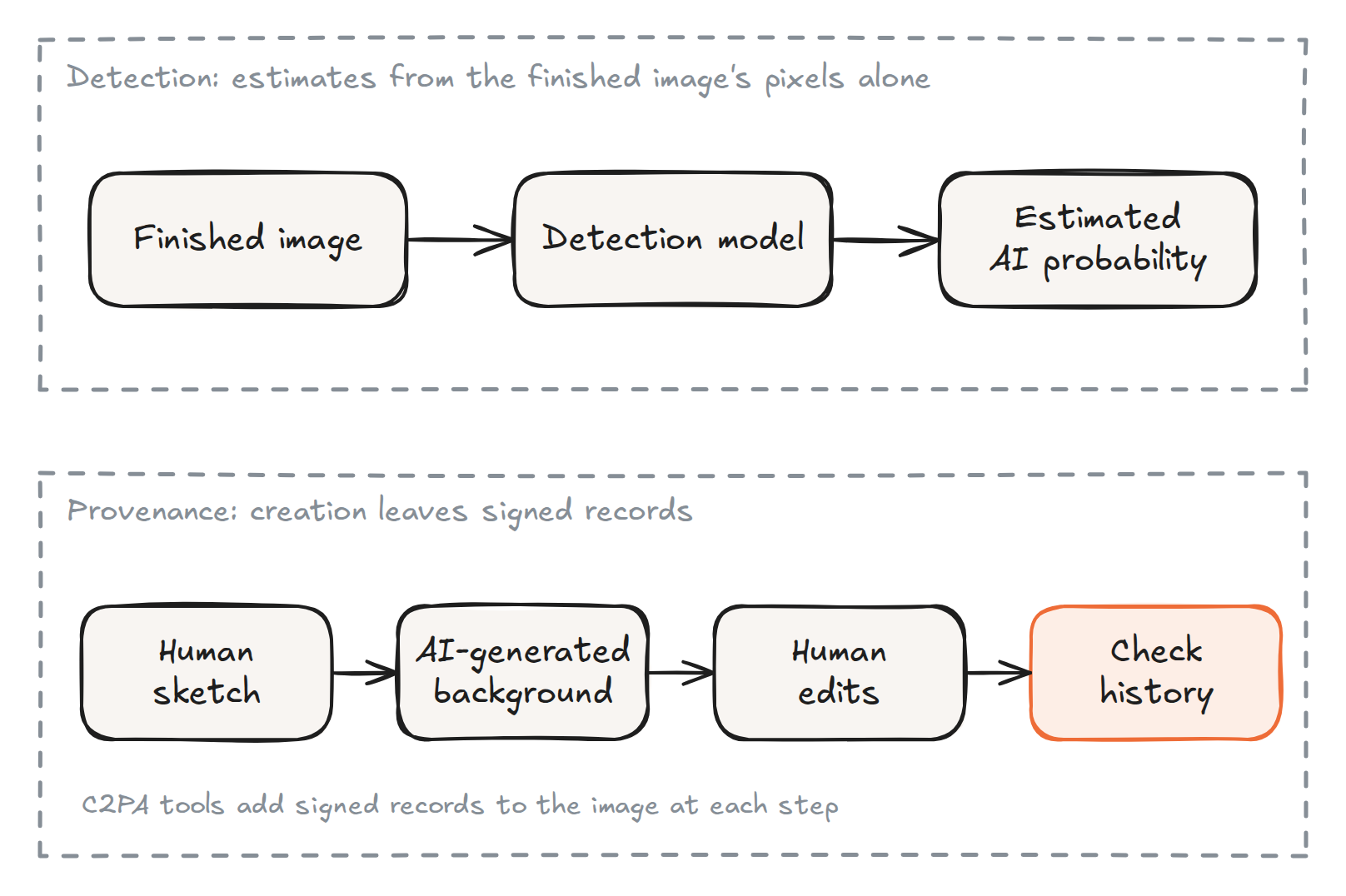
Going forward, even dividing work into human-made and AI-made will become increasingly difficult. A person might draw a sketch and use AI to make the background. They might spend hours editing an AI-generated image. They might render a 3D model and use generative AI to retouch only part of it. Sightengine also explains that what its model detects is whether the entire image was AI-generated.
In cases like these, what we need may be information about the process used to make this content, rather than a single label saying whether it is AI or not. This is also why Bivri plans to support checking C2PA information.
C2PA's Content Credentials is an open standard that records the origin and editing history of digital content in a form that can be cryptographically verified. Unlike a detection model that estimates likelihood from pixels, it checks signed records left by the tools used to create and edit the content.
This direction fits well with Bivri's principles. The platform provides information rather than deciding for people, and people make their own judgments based on that information.
Whose twenty years?
Let us return to the street artist. The tourist thought the drawing had taken five minutes. The artist said it had taken twenty years and five minutes.
Generative AI is now reducing those five minutes to a few seconds. That in itself is a remarkable technological advance. But as the time gets shorter, perhaps we more often forget the time behind it. The countless works that made a drawing possible, the time of the people who made those works, the forms of expression and choices they refined over years, and the models and tools built on top of them.
So the question "Who owns what AI makes?" does not have as simple an answer as it might seem. Perhaps the question we need to ask first is this.
Whose twenty years went into it?
And I would like to add one more question.
Can the person who put in those twenty years choose for themselves what to do?
Bivri does not want to build a platform that settles on one correct answer to generative AI. People who use AI and people who do not. People who want to protect their work and people who want it to be widely used. People who want to disclose that they worked with AI and people who want to prove their creative process. For these different choices to coexist, I believe the platform's job is not to choose for users, but to make the ability to choose a reality through technology.
- Data portability through AT Protocol
- Optional AI training protection through Dazzle
- Optional estimates of AI generation through Sightengine
- Future support for checking provenance and the creation process with C2PA
These may look like different technologies, but to Bivri they are all answers to the same question.
Who should control what I create?
At least for that question, I believe the answer should, as far as possible, be the creator themselves.
References
- Thomas Sowell, Basic Economics: A Citizen's Guide to the Economy (2000): the street artist and the "twenty years and five minutes" anecdote
- Glaze: What Is Glaze?: how Glaze works and its limitations
- Shan et al., Glaze: Protecting Artists from Style Mimicry by Text-to-Image Models (USENIX Security 2023): the Glaze paper
- AT Protocol: Protocol Overview: signed data repositories and account migration
- Sightengine: How can I detect AI-generated images and videos?: pixel-based detection and scores
- C2PA: the Content Credentials standard
- Paul Macdonald, Unsplash: cover photo (Unsplash License)
No comments yet.