

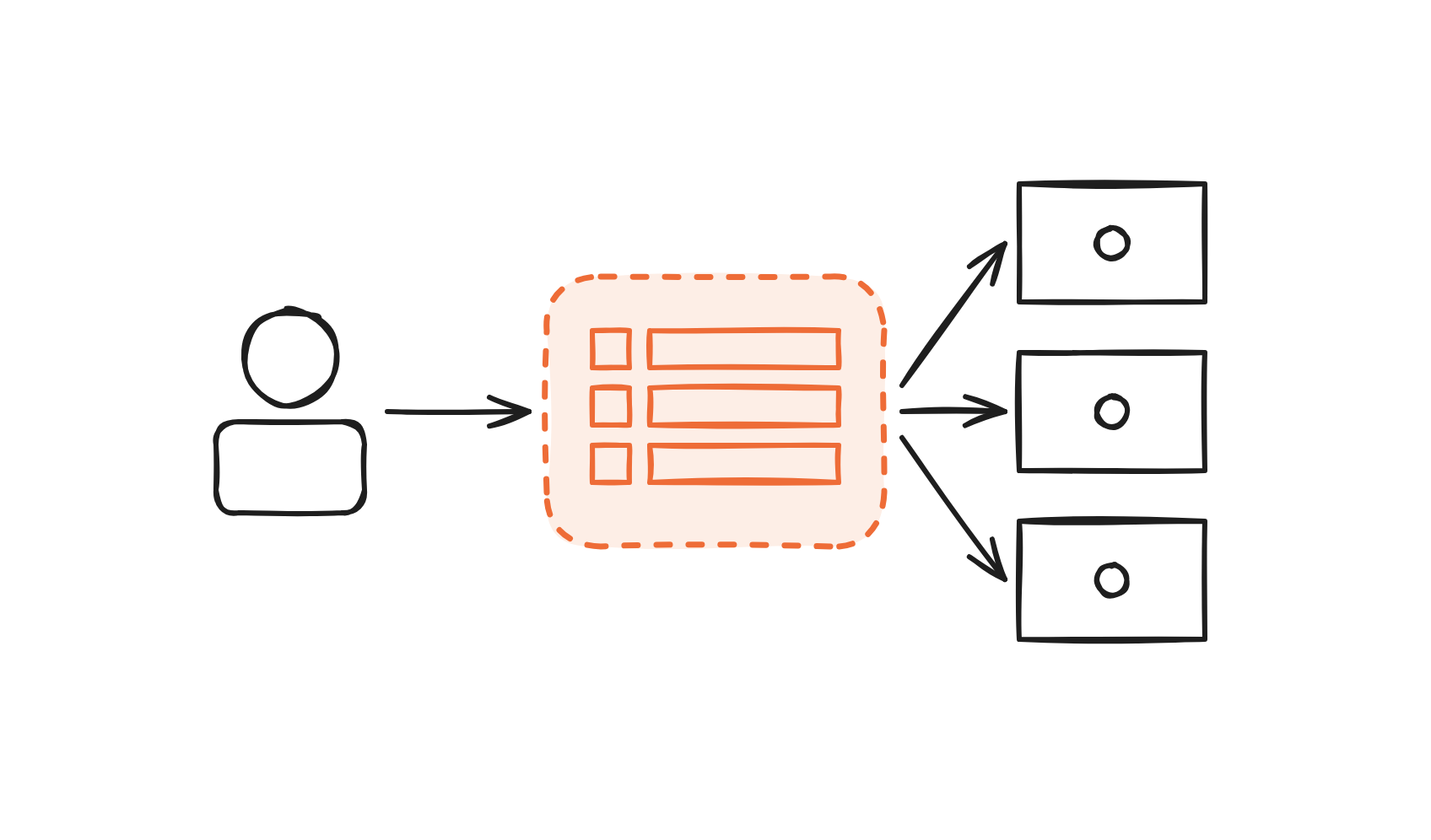
When a creator spends years posting artwork and gathering followers on one platform, that artwork and that follower list belong to the platform account. This post explains what that dependence leads to in practice, how AT Protocol addresses it, and what Bivri promises on top of it, and what it cannot promise yet.
What it means to depend on a platform
In December 2023, Twitch announced that it would shut down its service in Korea on February 27, 2024. Twitch said its network fees in Korea were 10 times higher than in most other countries and that it saw no sustainable way to keep operating there (Twitch: An Update on Twitch in Korea). Nothing was wrong with the service itself. Because of an external condition, operating cost, Korean streamers and viewers had to leave a platform they had used for years and move to other services such as CHZZK and SOOP.
Fortunately, Twitch said it would help streamers move their communities to other services and reached out to Korean services to prepare the transition. CHZZK offered a way for viewers to carry over the streamers they followed on Twitch and their subscription periods. That transition was possible only because the departing platform cooperated and the receiving platform prepared for it. Had either side not stepped in, viewers' subscription history and follow relationships would have disappeared with Twitch.
The reason data depends on a platform lies in how platforms are built. The backend of a large social service usually has three parts: a database that stores posts and follow relationships, an event log that records every change, and view servers that read the log and precompute feeds and search.
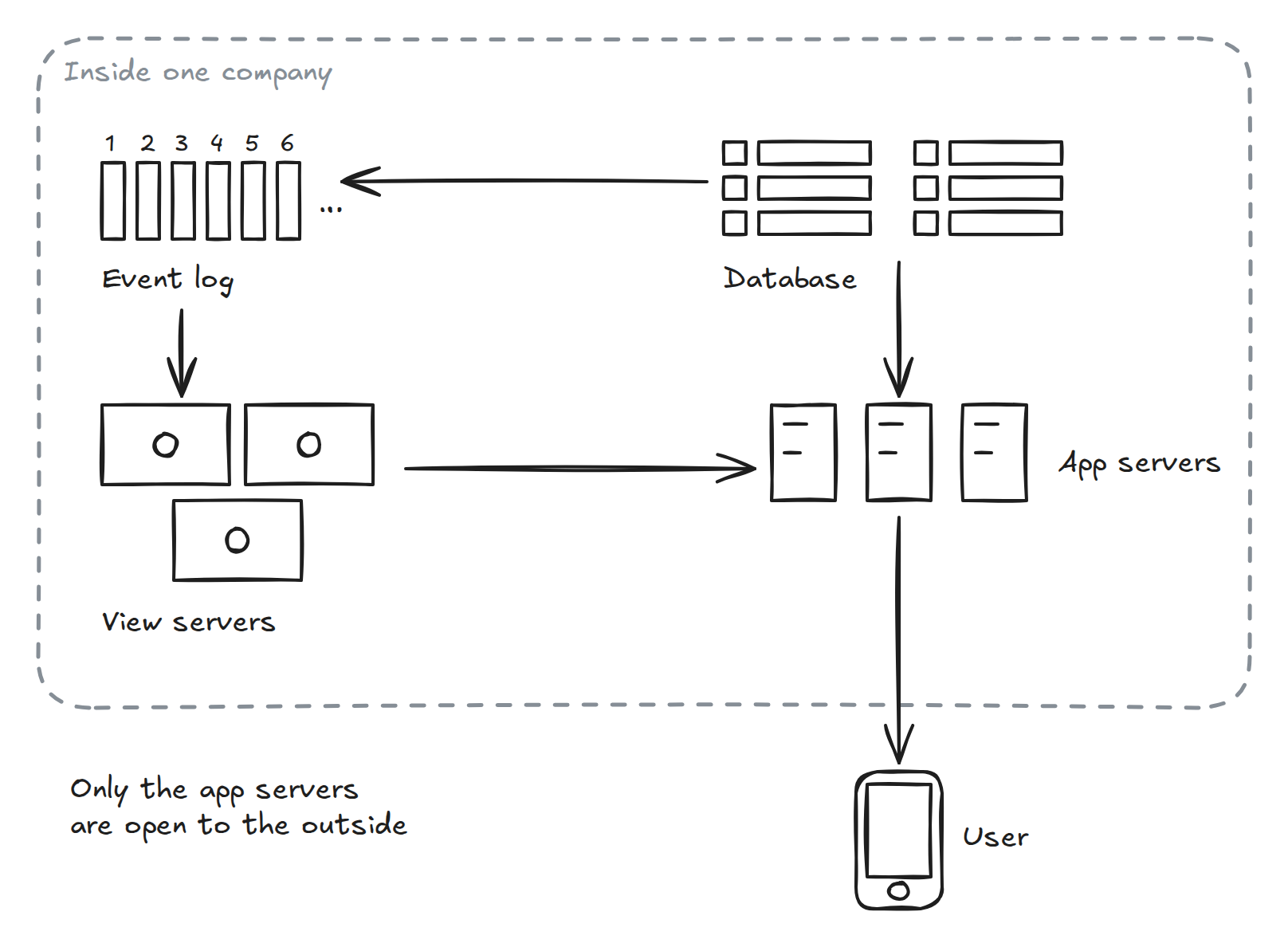
Because all three parts live inside one company, moving data to another service requires that company to hand it over. Bivri believes creators' artwork and followers should be able to move without depending on a platform's goodwill.
What AT Protocol is
In 2019, Jack Dorsey, then CEO of Twitter (now X), announced that Twitter would fund bluesky, a project to build an open and decentralized standard for social media. The goal he described was a protocol that should "not be owned by any one organization" (Bluesky: How It Started). At the end of 2021 the project became Bluesky, a company independent of Twitter, and in October 2022 it published AT Protocol (Authenticated Transfer Protocol) (Bluesky: The AT Protocol). The Bluesky app opened to everyone in February 2024.
AT Protocol keeps the backend structure of a large social service but turns the parts that used to live inside one company into public services that anyone can run and use (atproto: atproto for distributed systems engineers). The database becomes the PDS (Personal Data Server), which keeps one repository per account. The event log becomes the Relay, which merges changes from many PDSes into one stream, the firehose. View servers and app servers are bundled into an AppView, which builds each app's screens from that stream.
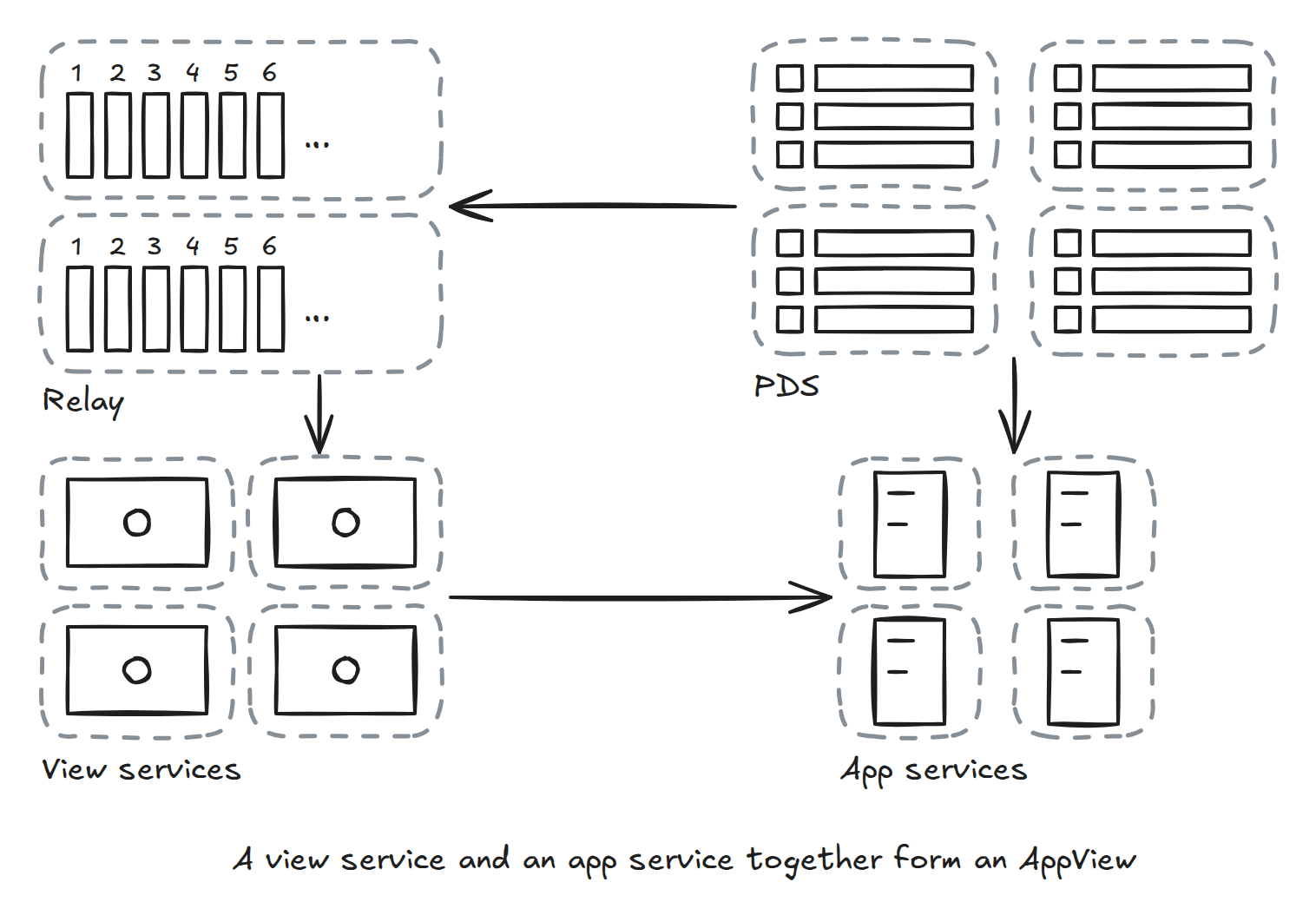
In this structure, data is anchored to the account, not the server. Each account has a DID, an identifier that does not change, and the DID document points to the account's current PDS. When an account moves to another PDS, only that location in the DID document changes, and follow relationships, which point at the DID, stay in place. Records in a repository are signed with the account's key, so an AppView can verify that a record belongs to the account even when it arrives through a Relay (atproto: Atproto Ethos).
A PDS only stores data and manages accounts; each app builds the product. An app defines its record format in a schema called a Lexicon, and a Lexicon name starts with the app's domain. An app can evolve its format freely, and because data written in that format is public, other apps can read it too.
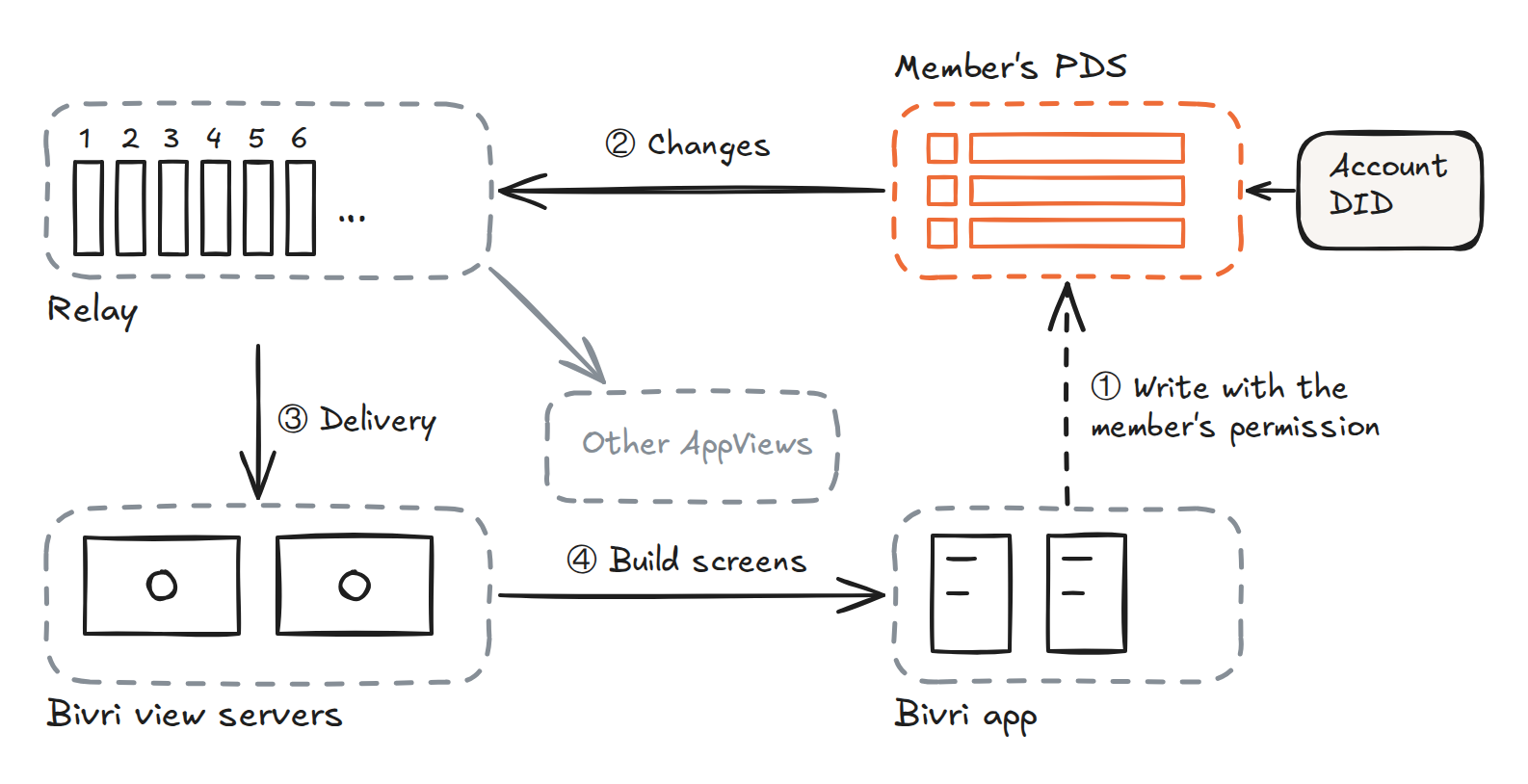
An app writes a record in the order shown. The app writes artwork to the member's PDS with the permission the member granted through OAuth (1). The PDS sends the change to the Relay (2), the Relay delivers it to every AppView, including the app's own view servers (3), and the app builds its screens from what the view servers computed (4). An app reads even its own records back from the Relay because other apps write to the same repository.
Why Bivri chose AT Protocol
Bivri is a community and commission service for digital artists. The Bivri team believed that when a platform shuts down or has to be left behind, as Twitch did, creators' artwork and follow relationships must remain without the platform's cooperation. AT Protocol guarantees that condition through the structure of the protocol rather than a service's promise. So instead of building a separate social network, Bivri adds an AppView for a creator community to the AT Protocol network.
- Sign-in is handled by the member's PDS. Members with a Bluesky account sign in with it; others create a new account on a PDS that Bivri runs. The Bivri app receives permission through OAuth and never receives the account password.
- Published artwork is written to the member's repository. The Bivri server writes artwork to the signed-in member's repository, not to Bivri's database. Artwork from a member who signed in with Bluesky is stored on that member's Bluesky PDS.
- Relationships made in other apps carry over. When Bivri suggests accounts to follow, it reads the Bluesky follow records in the member's repository and shows the ones that are on Bivri.
- The artwork format is a public Lexicon. Artwork is an
app.bivri.feed.artworkrecord, and other apps can read this format to display artwork.
Bivri is replaceable
Anyone can build an AppView that replaces Bivri. If Bivri changes in a direction that does not suit creators, they can move to another app and keep their artwork and follow relationships. "Atproto Ethos" calls this principle "credible exit." Rather than locking creators in, Bivri will grow by giving creators reasons to stay.
To that end, Bivri plans to make it easier for other services and developers to join this network.
- Labeler: A labeler is a moderation service that attaches labels such as "adult content" to accounts and posts. Bivri does not run a labeler today but plans to add one.
- Labeler and feed generator extensions: Bivri plans to support building or choosing labelers and feed generators (algorithm services that select lists of artwork).
- Developer documentation and SDK: Developers can already build an AppView with Bivri's Lexicons. Bivri is preparing developer documentation and an SDK to make that easier.
- Open-source example: Bivri is preparing to release a creator portfolio builder that uses Bivri's Lexicons as open source.
How far data sovereignty reaches
Data sovereignty in AT Protocol does not mean users control all data. On Bivri, its reach is as shown below.
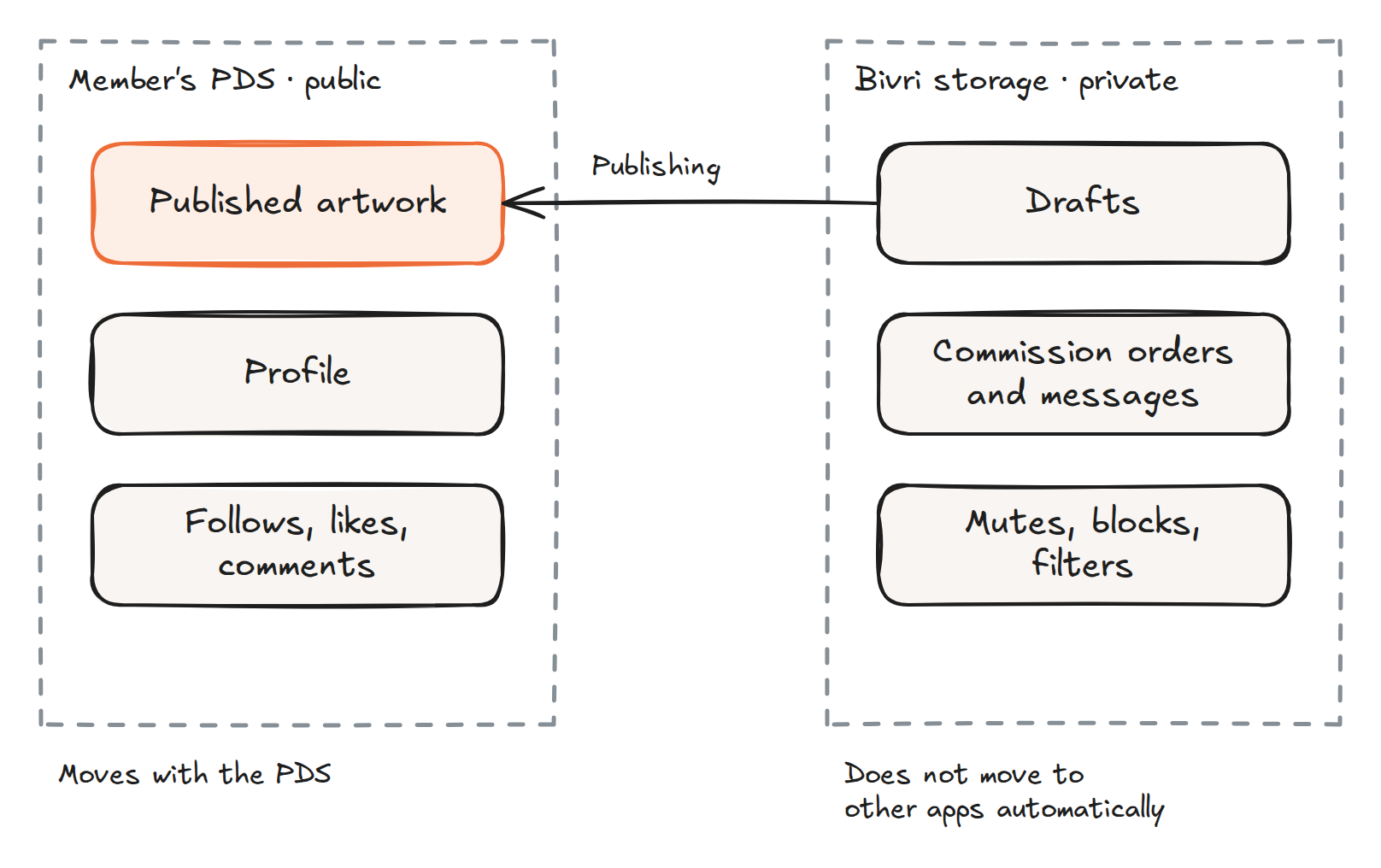
- Records on a PDS are public. The AT Protocol specification states that repository contents are "entirely public and verifiable" (atproto: Repository). So Bivri does not write unpublished artwork to the PDS and keeps it as a draft in Bivri's storage. Published artwork cannot be turned back into a draft.
- Deletion is certain only at the source. When a member deletes artwork, the record is removed from the PDS repository. Copies that other services received before the deletion may remain, depending on those services' policies.
- Data that must stay private remains on Bivri. Commission orders and messages must be visible only to the client and the artist, and mutes and blocks would be visible to the other person if made public, so they stay in Bivri's storage. This data does not move to other apps. In August 2026, Spaces, an AT Protocol extension for private data, was announced as an alpha (atproto: Spaces alpha). Once Spaces becomes a formal specification, Bivri plans to prepare to separate this data from its own storage and decentralize it.
- Moving an account takes several steps. To move an account, you export the repository and import it into the new PDS, re-upload images, and change the PDS location in the DID document (atproto: Account Migration). The Bivri app does not yet have a screen for moving an account to another PDS.
AT Protocol does not remove each service's operating policies either. Bivri can restrict accounts that violate its policies on Bivri's screens. What changes is that one service's decision does not end the account itself or its activity in other apps.
Summary
- When Twitch left Korea, viewers' records carried over because two platforms cooperated. Bivri wanted a structure in which creators' artwork and followers remain without that cooperation.
- AT Protocol splits a social service's database, event log, and view servers into public services, the PDS, the Relay, and the AppView, and anchors data to the account's DID.
- Bivri is an AppView that writes published artwork and public activity to the member's PDS. Anyone can build an AppView that replaces Bivri, and Bivri is preparing tools to help.
- Drafts, commissions, mutes, and blocks are still in Bivri's storage. Publishing cannot be undone, so please check before you publish.
References
- Twitch: An Update on Twitch in Korea: Twitch's announcement of its Korea shutdown and the reason
- Bluesky: How It Started: Twitter's bluesky project and the independent company
- Bluesky: The AT Protocol: the publication of AT Protocol
- atproto: atproto for distributed systems engineers: the three parts of a social backend and AT Protocol's structure
- atproto: Atproto Ethos: identity-based authority and credible exit
- AT Protocol specification: Repository: repository contents are public
- AT Protocol guide: Account Migration: the steps of moving an account
- AT Protocol blog: Spaces alpha: the status of the private data extension

No comments yet.